Troy-Bilt Storm 2410 Runs Rough or Surges: Choke, Fuel and Service Boundary
A Storm 2410 run-quality path built from the manufacturer troubleshooting table instead of assuming every surge is a dirty carburetor.
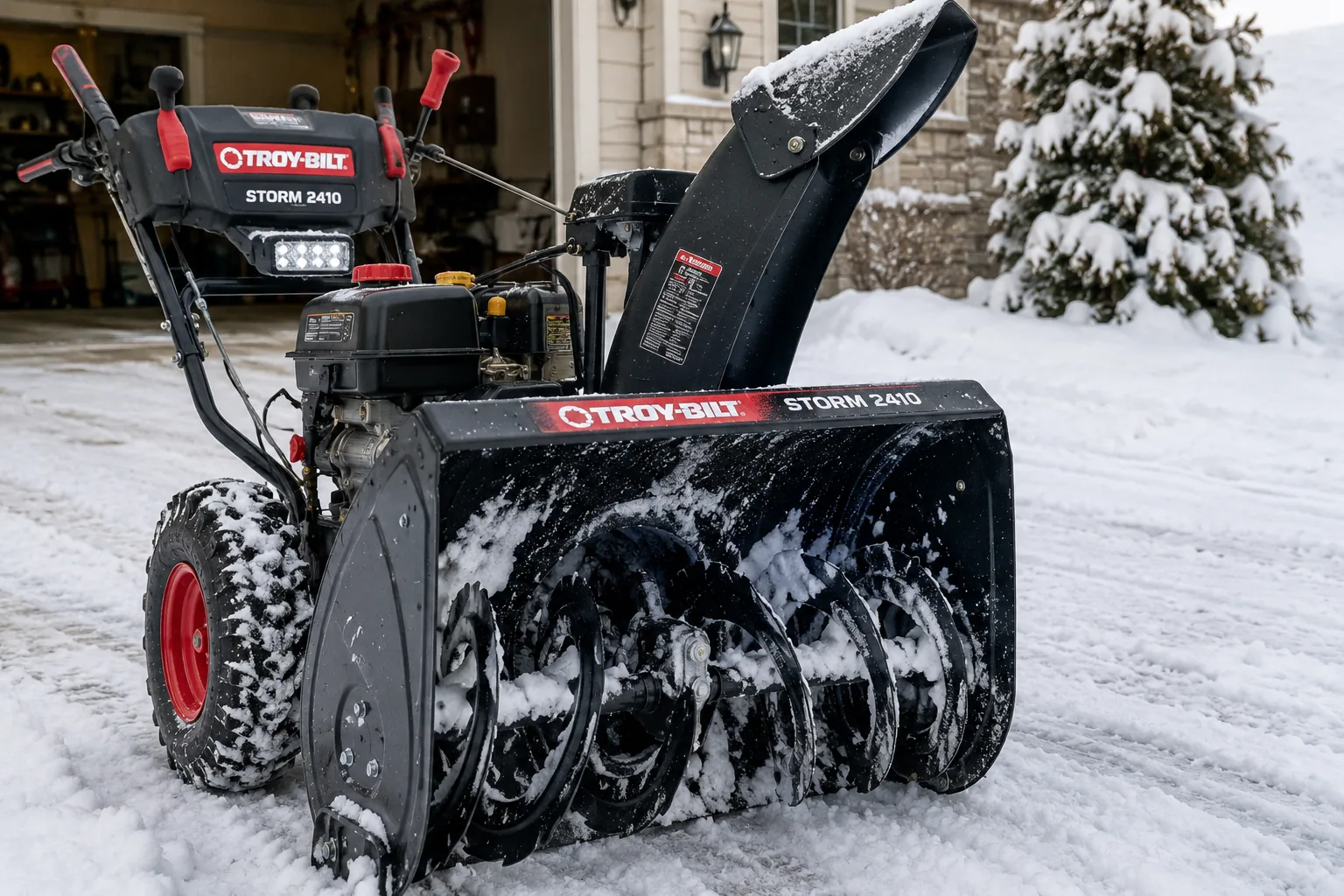
Applies to Storm 2410 family
Identifiers: Storm 2410 · 31BS6KN2766 · 31BS6BN2766 · 31AS6BN2723 · 31AS62N2766 · 31AS62N2711
Guide scope: Storm 2410 spans multiple 11-character Troy-Bilt product IDs and engine/manual revisions. Match the exact Product Identification Label and engine documentation before plug, carburetor or fuel-system parts are selected.
Always match the 11-character product ID before ordering parts.
The Storm 2410 troubleshooting table starts with running on CHOKE, stale fuel and water/dirt in the fuel system; carburetor adjustment and over-governed conditions are service-center branches.
Diagnose outdoors. Shut the engine down before fuel or spark-plug checks, and do not adjust governor or carburetor settings beyond the matched manual.
Diagnostic sequence
Work in order. The early checks are intentionally low-disassembly and model-specific; stop once the symptom changes or the fault is confirmed.
Is the choke still on?
Why this check: The manual lists continued CHOKE operation as the first erratic-RPM cause.
What to do: As the engine warms, move the choke toward RUN/OFF according to the matched engine instructions and observe whether the hunting clears.
Fuel age
Why this check: Stale fuel is a separate manufacturer-listed cause.
What to do: If storage history is unknown or the fuel is old, drain/service it according to the engine manual and refill with clean fresh fuel.
Water or dirt in fuel
Why this check: Contaminated fuel can create intermittent lean/rich behavior that feels like carburetor failure.
What to do: If contamination is suspected, stop and service the fuel system rather than repeatedly running the engine through the surge.
Carburetor adjustment boundary
Why this check: The troubleshooting table sends carburetor-adjustment faults to an authorized service center.
What to do: Do not turn mixture/governor screws by guess. Use the exact engine service information or a qualified service center.
Over-governed behavior
Why this check: Later Storm 2410 troubleshooting tables also list an over-governed engine as a service condition.
What to do: If RPM is abnormally high rather than merely hunting, stop use and have governor operation checked.
How to read this symptom on this model
A surging Storm 2410 is already running, so the diagnostic question is mixture/control stability rather than basic starting. Troy-Bilt lists an engine left on choke, stale fuel and water/dirt in the fuel system before the carburetor-adjustment service branch. That makes storage history and choke position high-value evidence.
The page also draws a safety boundary around governor and carburetor adjustment. Search results often invite screw-turning by sound, but an over-governed small engine can exceed safe speed. A generic “turn this screw until smooth” answer is not an acceptable model-aware repair path.
Storm 2410 is a family name, not one permanent 11-character machine identity. Troy-Bilt support exposes several Storm 2410 product IDs across production years, so use the chassis label and the matched engine documentation before applying engine-specific parts or adjustment details. The family-level troubleshooting order is still useful, but an engine part number or screw setting is not safe to universalize across every Storm 2410 badge.
Separate a warm-up choke mistake from a fuel-history problem. If the engine smooths out as soon as the choke is moved to its normal run position, preserve that result; it is direct evidence that the control state was contributing. If the choke is already in the proper run position and the engine continues to hunt, stale fuel or water/dirt in the fuel path moves higher on the list. Changing fuel and choke at the same time destroys that diagnostic information.
Also record whether the surge exists at no load or only appears when the auger is engaged. A rough engine that hunts while sitting still points more directly toward the engine/fuel branches in the troubleshooting table. An engine that sounds stable unloaded but becomes unstable only when the attachment takes snow load may be reacting to excessive load, an obstruction or another machine-side condition. That does not excuse engine service, but it keeps a load problem from being mislabeled as a carburetor problem.
The service boundary is deliberate. Troy-Bilt’s table routes carburetor-adjustment and over-governed conditions away from casual owner adjustment. If the engine speed is abnormally high, or if normal choke/fresh-fuel checks do not resolve the hunting, stop using ‘sound’ as the tachometer and move to the matched engine/service information. A smooth-sounding engine is not worth an unsafe governor setting.
On a Storm 2410 that hunts after starting, choke position is an observation with timing attached to it. The manual lists continued CHOKE operation as an erratic-RPM cause, so note whether the engine smooths as the choke is moved toward RUN during warm-up. If it does, that result is different from an engine that surges with the choke fully off. Do not compensate for a persistent surge by leaving partial choke on and then call the machine repaired.
Fuel history is the next separator because Troy-Bilt lists stale fuel and water or dirt in fuel as distinct branches. Record how long the fuel has been in the machine and whether contamination is suspected before adding fresh fuel or opening the fuel system. Correct one fuel condition, then retest. If the behavior is unchanged, the failed fuel-history branch still narrows the complaint; repeatedly mixing old and new fuel makes that evidence harder to interpret.
Carburetor and governor work is where owner-level diagnosis should stop. The Storm 2410 material sends carburetor-adjustment faults to authorized service, and an abnormally high governed speed is not the same complaint as ordinary hunting. Bring the exact 11-character product ID, warm/cold behavior, choke response, and fuel-history result to service. Those details let the next technician distinguish a run-quality problem from a wrong-model procedure or an unverified screw adjustment.
Before you order parts
Do not replace the carburetor before verifying that the choke is fully transitioned after warm-up and that the fuel is clean/fresh. If the machine’s exact product ID uses a different engine generation, match the engine manual before ordering fuel-system parts.
Before ordering a carburetor, write down the 11-character product ID, the engine label, whether the engine is cold or fully warm when it surges, and whether the choke must be partly applied to keep it running. Those observations are more valuable than a generic ‘surges’ description and prevent buying a carburetor for the wrong Storm 2410 generation.
Fresh fuel is a diagnostic step, not permission to mix a small amount into an unknown old tank and call the fuel problem ruled out. If storage history or contamination is questionable, follow the matched fuel-system guidance so the retest actually uses a known fuel condition.
Back to the exact model hub →Retest without creating a second problem
After correcting choke or fuel quality, run the engine outdoors unloaded through warm-up and listen for stable RPM. Then apply a modest auger load. If hunting returns only under load, preserve that distinction for service; if RPM is abnormally high at no load, stop rather than continuing to test.
After one correction, let the engine reach normal operating condition outdoors with both drive systems disengaged. Listen for a stable no-load speed with the choke in the documented run position. If it still hunts before any snow load is applied, do not proceed to a heavy clearing pass just to mask the symptom under load.
If no-load operation becomes stable, engage the auger briefly with the housing clear and then make a light, narrow pass. Record whether the roughness returns only under attachment load. That staged retest gives a service technician a useful split between engine/fuel instability and a load-related complaint instead of a parts list with no chronology.
Make sure this is the right symptom
If your machine is showing an adjacent symptom instead, switch paths before changing parts: won't start.
The same search phrase can lead to a different branch on another machine. Compare the nearest model-specific examples: Ariens Deluxe 24 (921069): runs briefly then stops · Honda HSS928A track family (HSS928AAT / HSS928AATD): engine stalls when auger engages.
Model-specific notes
- “Runs rough” and “starts then dies” are different failure patterns. Use this path when the engine keeps running but hunts, surges or is inconsistent.
- Carburetor replacement is not the first manufacturer step; fuel/choke history should be preserved before parts are changed.
Questions people get wrong on this model
Does surging always mean the carburetor is dirty?
No. Troy-Bilt lists choke position, stale fuel and fuel contamination before the carburetor-adjustment service branch. Do not replace the carburetor before verifying that the choke is fully transitioned after warm-up and that the fuel is clean/fresh. Carburetor replacement is not the first manufacturer step; fuel/choke history should be preserved before parts are changed.
Can I adjust the governor until it sounds smooth?
No. Governor and carburetor adjustment can create unsafe engine speed; use the matched service procedure or a service center. Contaminated fuel can create intermittent lean/rich behavior that feels like carburetor failure. The troubleshooting table sends carburetor-adjustment faults to an authorized service center. Later Storm 2410 troubleshooting tables also list an over-governed engine as a service condition.
What does a fresh-fuel retest tell me before carburetor work?
It removes one common operating-condition variable without changing hardware. If the surge changes with correct fresh fuel and normal choke position, that result is more useful than immediately altering governor or carburetor settings. Do not replace the carburetor before verifying that the choke is fully transitioned after warm-up and that the fuel is clean/fresh.
Primary-source trail
Manufacturer material used for this diagnosis. Verify the model/serial range before ordering parts or applying an adjustment.
Troy-Bilt Storm 2410 model support pageManufacturer model page with operator manuals, diagrams and model-number guidance.www.troybilt.com →Troy-Bilt Storm 2410 alternate model supportConfirms Storm 2410 family spans multiple 11-character model numbers.www.troybilt.com →Troy-Bilt Storm 2410 model 31BS6BN2766 supportManufacturer page confirms another Storm 2410 11-character model and exposes matched manuals.www.troybilt.com →