Honda HSS928A Engine Stalls When Auger Engages: Load or Lockup?
A high-value HSS928A split between low engine speed and a physically restricted or frozen snow-handling system.
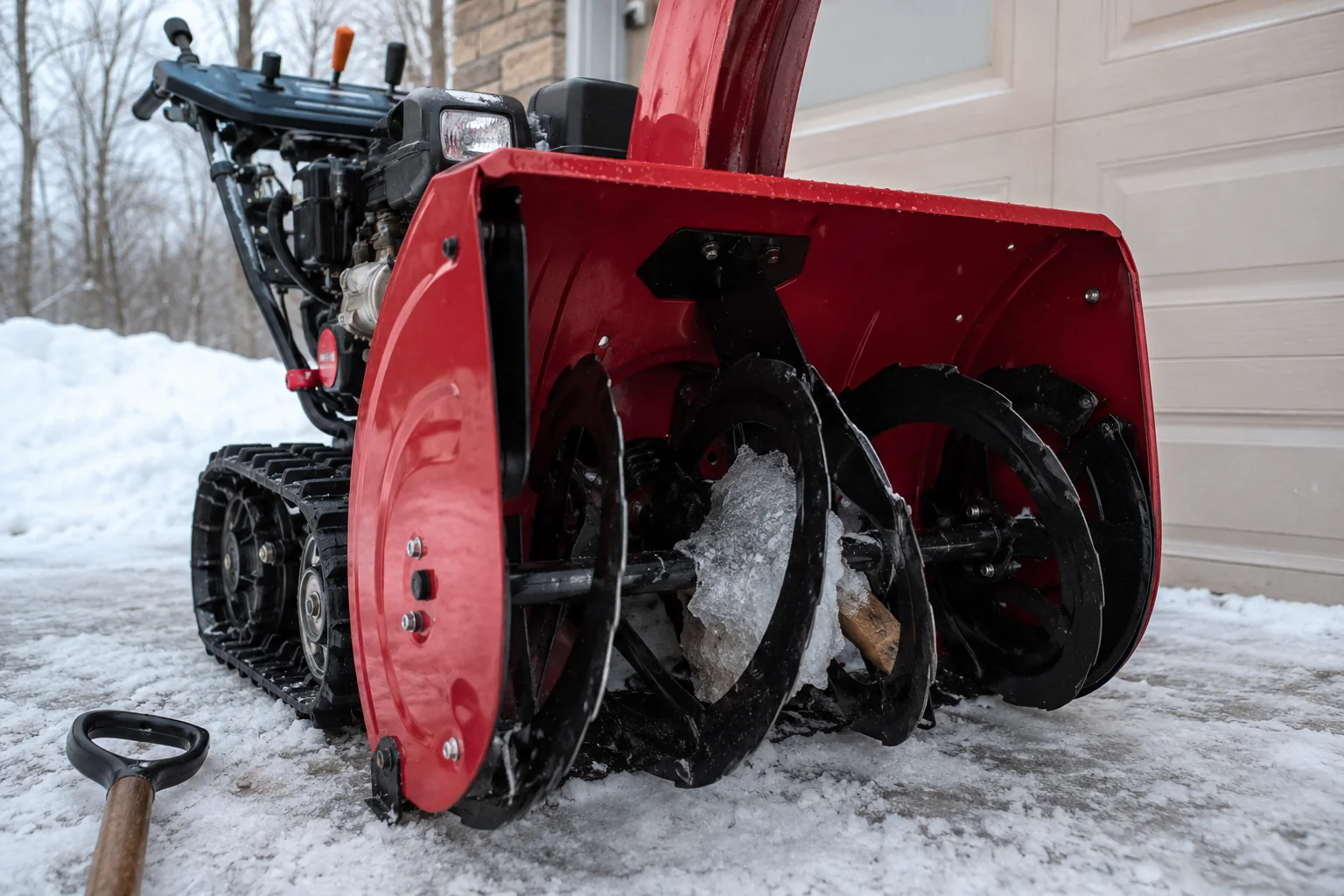
Applies to HSS928A track family (HSS928AAT / HSS928AATD)
Identifiers: HSS928A · HSS928AAT · HSS928AATD · HSS928APT · HSS928APTD · HSS928AT · HSS928ATD
Engine ID: Honda GX270
Frame / description code: SADA
Guide scope: Honda splits HSS928A owner manuals at frame serial SADA 2020201: A157 covers SADA 1000001–2020200 and A159 covers SADA 2020201+. This guide keeps to the troubleshooting branches verified across that HSS928A manual family and requires the frame serial before revision-specific work.
Honda splits HSS928A owner manuals at frame serial SADA 2020201. Match the full model name, resolve the frame serial range, then record both frame and engine serial numbers before ordering parts or escalating service.
This model has serial-range boundaries — resolve the serial before using a manual →
Honda lists engine speed too low, a restricted chute, a foreign object stopping the auger and an auger frozen by ice when the engine stalls as the auger clutch is depressed.
Treat an immediate stall at auger engagement as a possible mechanical lock. Stop the engine, wait for all parts to stop and remove the spark-plug cap before inspecting the chute/auger.
Diagnostic sequence
Work in order. The early checks are intentionally low-disassembly and model-specific; stop once the symptom changes or the fault is confirmed.
Throttle speed before engagement
Why this check: Honda’s first correction is to keep the engine at FAST when engaging the auger clutch.
What to do: Set FAST throttle and do not repeatedly engage the auger at low idle to test a stall.
Chute restriction
Why this check: A blocked discharge path can overload the snow-handling mechanism when the clutch engages.
What to do: Stop fully, disconnect the spark-plug cap and clear with the snow clearing bar.
Foreign object
Why this check: Honda specifically lists an object stopping the auger from rotating.
What to do: Inspect the housing only after shutdown; never use the clutch to “power through” an obstruction.
Frozen auger
Why this check: Ice locking the auger is another explicit cause in the HSS928A troubleshooting table.
What to do: Thaw/clear the frozen mechanism safely before another engagement test.
If the engine still stalls unloaded
Why this check: A recurring stall with a clear, free auger no longer matches the simple obstruction branches.
What to do: Stop repeated clutch cycling and escalate with frame/engine serial numbers and the exact stall history.
How to read this symptom on this model
This symptom has a precise trigger: the engine changes state when the auger clutch lever is depressed. Honda’s current HSS928A owner manual gives four owner-level causes for that exact event: engine speed too slow, a restricted discharge chute, a foreign object stopping the auger, or an auger frozen by ice. Start with those four branches before turning the page into a general carburetor tune-up.
Standardize engine speed first. Honda tells the operator to keep the throttle in FAST when engaging the auger. If the engine is intentionally idling or at a reduced setting, the attachment load can pull speed down immediately. Correcting the throttle position is therefore a clean first test; changing a plug or carburetor before standardizing the operating setting makes the load test ambiguous.
Next separate airflow restriction from a mechanically locked auger. A packed discharge chute can load the system because snow has nowhere to go, while a foreign object or frozen auger directly prevents rotation. Both can stall the engine at clutch engagement, but the repair path is different. Shut the engine off and remove the spark-plug cap before inspecting; use the snow-clearing bar for the chute and never reach into the housing.
A freeze-up branch is especially common after wet snow is left in the machine and then refreezes. If the auger will not move because of ice, repeated clutch engagement is not a thawing method. It can shock-load belts and clutch components. Move the machine to a suitable place to thaw or clear the ice safely, then recheck the complete snow-clearing mechanism before powered testing.
If a foreign object was found, inspect the auger/blower and shear bolts before restarting. Honda explains elsewhere in the same manual that the shear bolts are protective parts designed to break before more expensive auger/blower damage. A removed object does not prove the system is ready to run if a shear bolt, auger section or blower component was damaged during the jam.
Do not merge this exact symptom with Honda’s separate “engine has low power” table. Low power while blowing wet/deep snow includes additional load, spark-plug and stale-fuel branches. An engine that runs normally until the instant the auger clutch is depressed gives stronger evidence for the four auger-engagement branches first. Preserve that trigger rather than broadening the diagnosis too early.
The HSS928A manual changed at frame serial SADA 2020201, so record the frame serial and use A157 or A159 as appropriate. The current A159 troubleshooting table retains these core branches, but revision matching still matters for other procedures, parts and illustrations.
If the auger housing is clear, the mechanism is not frozen, throttle is FAST and the engine still stalls during a no-snow engagement, stop repeated clutch tests. A failed no-load retest after the four owner-level causes are ruled out is much stronger dealer/service evidence than multiple heavy-load stalls.
The timing of the stall is the key clue. If the engine idles normally and dies the instant the auger clutch is engaged with the housing empty, suspect attachment drag or lockup before blaming snow load. If engagement is normal with no snow but the engine stalls only in a deep heavy pass, reduce travel speed and swath first. Repeatedly engaging a mechanically locked attachment can damage belts or driveline parts, so stop the powered test if the auger/impeller cannot turn freely with the machine safely disabled.
Honda gives this symptom a very short, useful branch: when the engine stalls as the auger clutch is depressed, first make sure the engine is actually at FAST, then look for a restricted discharge chute, a foreign object stopping the auger or an auger frozen by ice. That sequence is important because a mechanically locked attachment can drag a healthy engine to a stop. Do not respond to an engagement stall by immediately adjusting the carburetor or governor. Shut the engine down, clear the chute and housing with the prescribed tool/procedure and confirm that the attachment is no longer frozen or obstructed before making another powered test.
The retest should separate engine weakness from attachment overload. With the chute clear and the machine in an open area, bring the engine to FAST and engage the auger briefly without feeding snow. If it now holds rpm, the original clog, object or freeze was the stronger explanation. If it still stalls immediately with a free attachment, stop repeating the engagement and move to the matched service path; repeated clutch-in tests can damage belts or other drive parts without adding useful evidence. If the engine also lacks power with the auger disengaged, use the separate HSS928A low-power guide rather than forcing the auger-stall page to explain an engine that is already weak at no load.
Before you order parts
Before buying a belt, clutch or engine part, verify FAST throttle and physically rule out a restricted chute, foreign object and frozen auger with the engine off and spark-plug cap removed. These are Honda’s exact first branches for this symptom.
If a jam was present, inspect the shear bolts and visible snow-clearing mechanism before replacing a bolt and immediately loading the auger again. Repeated shear failure or continued binding means the overload source remains.
Do not jump to carburetor work because the engine stalls under auger engagement. If it runs normally unloaded and the stall occurs exactly at clutch engagement, preserve that event and exhaust the attachment-load branches first.
Back to the exact model hub →Retest without creating a second problem
After clearing the problem, start outdoors with the throttle in the normal FAST snow-clearing position and the drive clutch released. Engage the auger briefly with no snow. If the engine stays stable, release the auger and verify the mechanism stops before continuing.
Next make a very light, narrow snow pass. A machine that passes the no-load test but stalls only when overfed has different evidence from one that stalls instantly with an empty housing.
If it stalls again during the no-load engagement after the listed causes are ruled out, stop testing and take the model/frame serial plus the exact trigger into Honda service. Repeatedly shock-loading the attachment adds risk without adding useful information.
Make sure this is the right symptom
The same search phrase can lead to a different branch on another machine. Compare the nearest model-specific examples: Ariens Deluxe 24 (921069): runs briefly then stops · Troy-Bilt Storm 2410 family: runs rough or surges.
Model-specific notes
- This symptom is more specific than “engine runs rough”: the trigger is auger engagement, which makes attachment load central to diagnosis.
- Repeatedly engaging a locked auger can turn a simple freeze or obstruction into belt or drive damage.
Questions people get wrong on this model
Should I keep feathering the auger lever until it breaks the ice loose?
No. A frozen auger is an explicit Honda stall cause; shut down and clear/thaw it instead of forcing engagement. Ice locking the auger is another explicit cause in the HSS928A troubleshooting table. A recurring stall with a clear, free auger no longer matches the simple obstruction branches.
What if it stalls even with no snow in the housing?
Confirm the mechanism rotates freely after shutdown. If the external load branches are ruled out, stop repeated testing and use Honda service support. A machine that passes the no-load test but stalls only when overfed has different evidence from one that stalls instantly with an empty housing.
Can packed or frozen snow make the engine stall as soon as the auger engages?
Yes. A locked or heavily obstructed attachment can impose an abrupt load on the engine. Shut down, clear the housing safely and verify free movement before repeating the engagement test or blaming carburetion. This symptom is more specific than “engine runs rough”: the trigger is auger engagement, which makes attachment load central to diagnosis.
Primary-source trail
Manufacturer material used for this diagnosis. Verify the model/serial range before ordering parts or applying an adjustment.
Honda HSS928A owner manual 00X31V45 A157Official troubleshooting, serial-number, operating and specification tables for HSS928A frame serial SADA 1000001–2020200.cdn.powerequipment.honda.com →Honda HSS928A owner manual indexOfficial serial-to-manual crosswalk; HSS928A changes to manual A159 at SADA 2020201.powerequipment.honda.com →Honda HSS928A owner manual 00X31V45 A159Official current-range manual for HSS928A frame serial SADA 2020201+; troubleshooting tables retain the same core no-start, drive and snow-handling branches.cdn.powerequipment.honda.com →Honda HSS928AT / HSS928ATD product supportHonda Power Equipment product data for full model names, GX270 engine, hydrostatic track drive, electric joystick chute and AT versus ATD starting-system differences.powerequipment.honda.com →