Toro 721 E Electric Starter Not Working or Frozen After Snow
Separate extension-cord/power issues from freeze-up and starter overheating on the 38753.
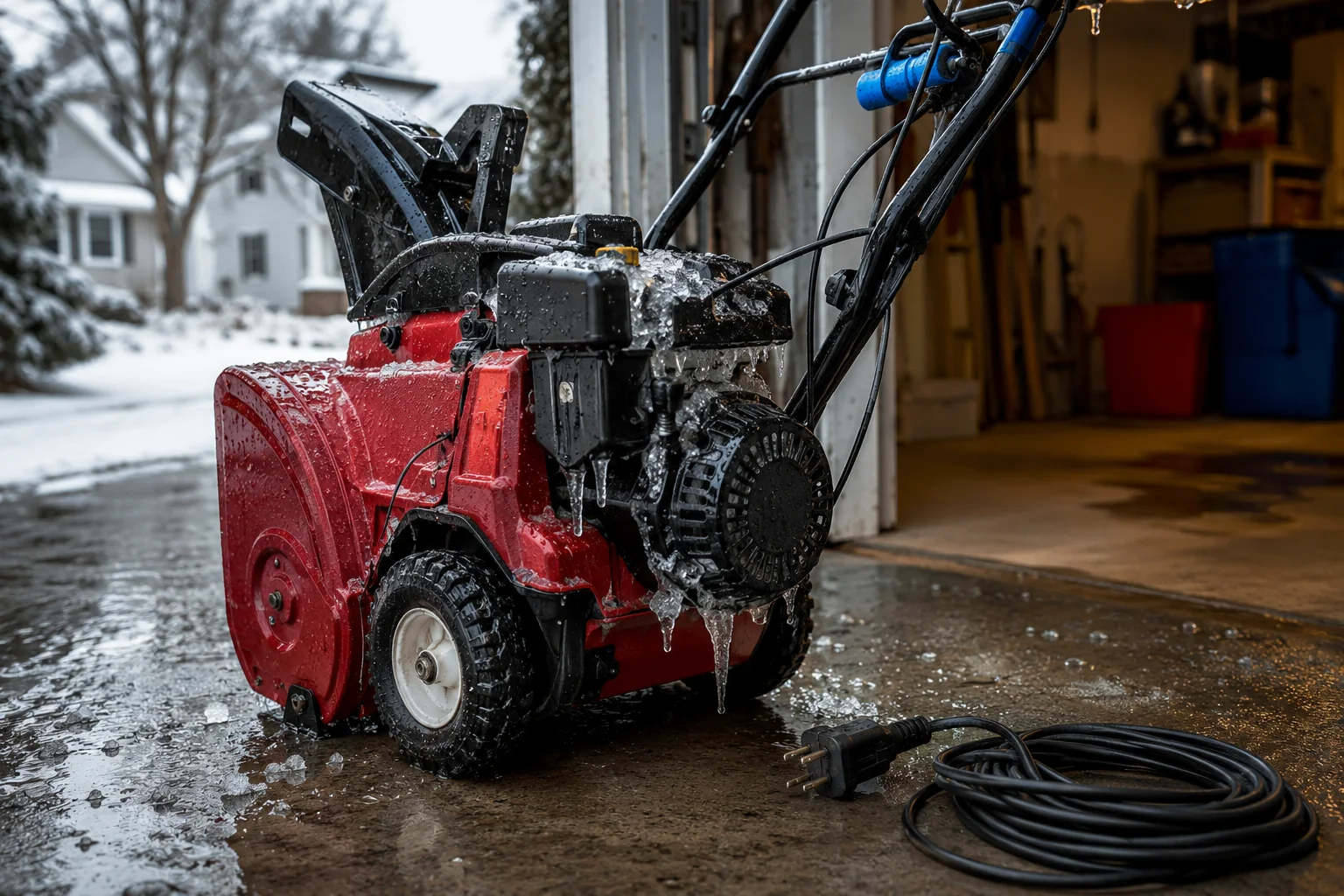
Applies to Power Clear 721 E (38753)
Identifiers: 38753 · 721 E
Engine ID: Toro 212cc
Guide scope: Hard starter timing, cord and GFCI details on this page follow Toro operator manual 3439-829 for model 38753 serial 406836564 and up. Earlier serial 400000000–406836563 uses manual 3429-269; resolve the serial before applying those numbers.
Model 38753 spans multiple serial ranges. Use the serial resolver below before assuming a manual or parts catalog.
This model has serial-range boundaries — resolve the serial before using a manual →
721 E 38753 is not the QZE 38756
This diagnosis is scoped to model 38753. The sibling 38756 is the 721 QZE and adds the Quick Shoot chute-control context, so confirm the model/serial label before using a parallel-looking QZE procedure.
Check the approved outdoor cord/GFCI supply and freeze-up prevention before assuming the starter motor failed.
Damaged cords create shock and fire hazards. Do not use a damaged extension cord or bypass GFCI protection.
Diagnostic sequence
Work in order. The early checks are intentionally low-disassembly and model-specific; stop once the symptom changes or the fault is confirmed.
Cord and outlet
Why this check: Toro requires a UL-listed outdoor 16-gauge cord, maximum 50 ft, connected to a GFCI outlet.
What to do: Inspect the cord and verify the outlet before pressing the starter button.
Connection order
Why this check: The manual specifies connecting to the machine before the outlet.
What to do: Follow the manual connection and start sequence; unplug whenever you are not starting.
Freeze-up
Why this check: Toro includes a post-use procedure to prevent electric/recoil starters from freezing.
What to do: Remove snow/ice and follow the after-use starter exercise described in the manual.
Overheat protection by time
Why this check: Repeated long starter cycles can overheat the motor.
What to do: Respect the 5-second on/5-second off attempt limit and long cool-down after the maximum series.
How to read this symptom on this model
An electric-start complaint on the Power Clear 721 E has two sides: the machine’s starter path and the household power feeding it. Toro specifies a GFCI-protected outlet and a UL-listed 16-gauge outdoor extension cord no longer than 15 m (50 ft). A dead starter should therefore not be condemned until the outlet, cord condition and connection sequence are verified.
Toro also specifies the order: connect the power cord to the snow blower’s electric-start plug first and then to the GFCI outlet. Inspect the cord before use; a damaged cord is a shock/fire hazard and should not be used. If the machine starts with recoil but the electric starter does nothing, that narrows the symptom toward the electric-start path, but it still does not tell you whether the outlet, cord, frozen mechanism, switch or starter itself is at fault.
Freeze-up after operation is a separate and common-looking branch because Toro includes a dedicated prevention routine. After snow use, the manual tells the operator to remove snow and ice, free the chute, and—with the key removed—exercise the recoil starter several times or connect power and press the electric-start button once on electric-start models. If a starter is dead only after wet snow and returns after thawing, preserve that pattern as evidence instead of treating the temporary recovery as proof that an electrical part was replaced or repaired.
Cranking history matters too. Toro limits electric-start use to no more than 10 attempts at 5 seconds on and 5 seconds off. If the engine has not started after that series, the manual requires at least 40 minutes of cooling before trying again. A starter that became weak or silent only after long continuous cranking may be overheated; immediately ordering a new starter would erase a very relevant cause created during diagnosis.
Separate 'electric starter does not crank' from 'starter cranks but engine does not fire.' The first symptom belongs to the outlet/cord/freeze/starter path; the second belongs to the engine-start sequence and fuel/ignition branches. Recoil starting is a useful cross-check because model 38753 has both electric and recoil start: if recoil turns and starts the engine normally while the electric path remains dead on a verified supply, the engine itself has not demonstrated a no-start condition.
Toro's after-use freeze-prevention instructions explain why a starter complaint can be weather-dependent. The later 3439-829 manual tells the operator to let the engine run briefly after throwing snow, remove snow and ice around the chute/base, and exercise the starting mechanisms so wet snow does not freeze them in place. If the electric starter is only unavailable after a wet session and recovers after thawing, correct the after-use routine before treating the behavior as a persistent electrical failure.
Use recoil behavior only as a separator. If the recoil starter turns and starts the engine normally while the electric starter stays silent, the engine fuel/ignition path is less likely to be the reason the button does nothing. Keep the diagnosis on the cord, outlet, starter and freeze-up side, and never bypass GFCI protection or exposed wiring to prove the motor. If both starting methods crank but the engine will not fire, leave this page and use the no-start sequence instead.
Recoil-start behavior is a useful comparison because it separates the engine from the 120-volt starter path without bypassing safety devices. If recoil turns and starts the engine normally while the electric starter remains silent with the approved outdoor cord and a working GFCI outlet, the fuel/ignition system is much less likely to explain the push-button failure. After wet-snow use, also give freeze-up prevention and thawing a chance before condemning the starter motor. Keep every electric-start attempt inside Toro’s specified duty cycle; repeated long cranks can overheat a healthy starter and create a second fault while you are trying to diagnose the first.
Before you order parts
Before buying any starter component, verify a known-good GFCI outlet, inspect the entire outdoor extension cord, stay within the 16-gauge/50-foot requirement and use the specified connection order. Do not substitute a light-duty indoor cord, bypass GFCI protection or keep the machine plugged in between attempts. Toro explicitly tells the operator to unplug the power cord whenever the machine is not being started.
If snow or ice is packed around the machine after the previous session, thaw and clean it before drawing an electrical conclusion. If the starter has already been used for a full series of attempts, allow the required 40-minute cooling interval. After two unsuccessful full series, Toro directs the user to an Authorized Service Dealer rather than continued repetitive cranking. That is a useful stop point for this guide as well.
Do not use starter noise alone to infer a failed motor. Note whether the starter is completely silent, hums without turning, turns the engine slowly, or turns it normally while the engine fails to fire. Those observations lead to different branches and give an Authorized Service Dealer much better evidence than a blanket 'electric start broken' description.
Back to the exact model hub →Retest without creating a second problem
After correcting the supply or thawing the machine, reconnect in the manual-specified order and make one short electric-start attempt. If another attempt is required, preserve the 5-second off interval rather than holding the button continuously. If the starter now operates normally after thawing, focus prevention on the after-use freeze-up routine instead of replacing a component that has not demonstrated a persistent failure.
If the verified outlet and cord are good, the machine is thawed, the starter has cooled and the electric-start path remains nonresponsive while recoil starting still works, stop before opening mains-connected components. Record the model/serial range and the exact electrical observations for service. That produces a cleaner diagnosis than repeatedly changing cords, bypassing safety protection or disassembling a line-powered starter without the appropriate service procedure.
If recoil is available, use it only as a diagnostic comparison under the normal start procedure; do not repeatedly alternate both starters after the electric unit has reached its duty-cycle limit. Once the electric starter has cooled, one controlled comparison on a verified outlet is enough to decide whether the failure is persistent or freeze/supply related.
Make sure this is the right symptom
If your machine is showing an adjacent symptom instead, switch paths before changing parts: won't start.
The same search phrase can lead to a different branch on another machine. Compare the nearest model-specific examples: Ariens Deluxe 24 (921069): electric start button not working · Toro Power Clear 721 QZE (38756): electric starter frozen or not working.
Model-specific notes
- A starter that works after thawing is not evidence of a fuel-system repair need.
- The recoil starter can be used as a comparison point, but a running engine still does not prove the electric circuit is healthy.
Questions people get wrong on this model
Can I use a 100-foot light-duty extension cord?
The covered manual specifies a UL-listed 16-gauge outdoor cord no longer than 50 ft. Before buying any starter component, verify a known-good GFCI outlet, inspect the entire outdoor extension cord, stay within the 16-gauge/50-foot requirement and use the specified connection order. Do not substitute a light-duty indoor cord, bypass GFCI protection or keep the machine plugged in between attempts.
How long can I hold the electric-start button?
Toro specifies short 5-second attempts with rests, not continuous cranking. After two unsuccessful full series, Toro directs the user to an Authorized Service Dealer rather than continued repetitive cranking. After correcting the supply or thawing the machine, reconnect in the manual-specified order and make one short electric-start attempt.
What does a normal recoil start tell me about an electric-start complaint?
It helps separate an electric cord/outlet/starter-path problem from a basic engine no-start. If recoil cranks and starts the engine normally while the electric starter remains dead, keep diagnosis on the electric-start side and do not bypass GFCI or starter wiring. If the verified outlet and cord are good, the machine is thawed, the starter has cooled and the electric-start path remains nonresponsive while recoil starting still works, stop before opening mains-connected components.
Primary-source trail
Manufacturer material used for this diagnosis. Verify the model/serial range before ordering parts or applying an adjustment.
Toro Power Clear 721 Operator Manual 3439-829 Rev BOfficial current operator manual covers model 38753 serial 406836564 and up; includes the 2–3 mm control-cable gap, disengaged-cable slack requirement, rotor-blade wear indicator and blades-plus-scraper replacement boundary.www.toro.com →Toro Power Clear 721 Interactive Operator ManualOfficial interactive manual for the same later 38753 generation, with control-cable, rotor-stop, wear, fuel, starting and freeze-up guidance.manuals.toro.com →Toro 38753 Parts & Manuals — current serial rangeOfficial current-range model page confirms 38753 serial 416153644+ still uses operator manual 3439-829 / 3439-830.www.toro.com →Toro 38753 product page — serial-range resolverOfficial product page exposes the model 38753 serial-range selector so later manual coverage can be resolved before applying an adjustment or replacement decision.www.toro.com →